
Money Buys a Roster. It Doesn't Build Leaders.
A sweep a year in the making
On October 15, 2026, the Milwaukee Brewers beat the Los Angeles Dodgers 6-4 to finish a four-game sweep of the National League Championship Series. A year earlier, the Dodgers had swept them in the same round.
Milwaukee trailed in every game of the series and won all four. Game 4 was typical: down 4-0 in the second inning, the Brewers came back on a sixth-inning home run and a bullpen that kept stranding the tying run. According to AP and ESPN, they are the first team in Major League history to sweep the club that swept them the postseason before, and the first to sweep a best-of-seven series in which they trailed in every game.
It is a good baseball story. It is also one of the clearest pictures we have seen of something we deal with every week: the difference between hiring talent and building it.
What payroll buys, and what it doesn’t
The Dodgers entered the 2026 postseason with a payroll of about $338 million, second in baseball. The Brewers were 19th, at about $143 million: less than half.
It would be easy to turn that into a slogan about money not mattering. It would also be wrong. The Dodgers won the previous two World Series, and ESPN’s Jeff Passan has pointed out that both clubs excel at the same thing: getting more out of players through scouting, analytics and coaching. A four-game series is a small sample, and analysts at CBS Sports have cautioned against reading these playoffs as proof of anything about how baseball should be financed.
The narrower point holds up better. Money buys a roster. It does not, by itself, build the habits that show up when you are down four runs in the second inning. Milwaukee has to build those, because it cannot buy its way around the problem.
Three habits that showed up in October
They develop instead of buy. The NLCS MVP, first baseman Jake Bauers, was once a highly regarded prospect who struggled to find consistency before he reached Milwaukee. Manager Pat Murphy has named Bauers as an example of how the club works: give players who never got a clean entry to the majors a real chance, and help them improve. Murphy says Milwaukee does business that way “out of necessity.”
They hold the standard without losing the person. In September, Murphy pulled his starting catcher, William Contreras, from a game after he didn’t run hard on a ground ball. The next night, Contreras dove headfirst into first base on a routine grounder, and Murphy was laughing in the dugout. As MLB.com’s Zach Sweet put it, the relationships are strong enough to hold up when Murphy enforces the standard. It runs the other way too: when Murphy pulled pitcher Robert Gasser from a September 1 start Gasser was disappointed in, he took time to tell him what he had liked. The consequence was real, and so was the relationship.
They learned from the loss. After the 2025 sweep, Murphy acknowledged that his hard-nosed approach to player workloads may have worn some players down by the postseason. A leader who names his own contribution to a failure is doing the thing he asks his players to do.
The business version: the accidental manager
Most growing companies don’t have a payroll problem with their managers. They have a development problem.
The pattern we see most often goes like this. The best salesperson, technician or shift lead gets promoted, because they were the best at the job. Nobody defines what the new job is. Nobody trains them on expectations, feedback or documentation. Nobody is responsible for their growth. Within a few months the owner or COO is solving that manager’s problems for them, one conversation at a time.
Gallup’s data says the cost of that pattern is large:
- Managers account for at least 70% of the variance in team engagement across business units (Gallup, State of the American Manager, 2015).
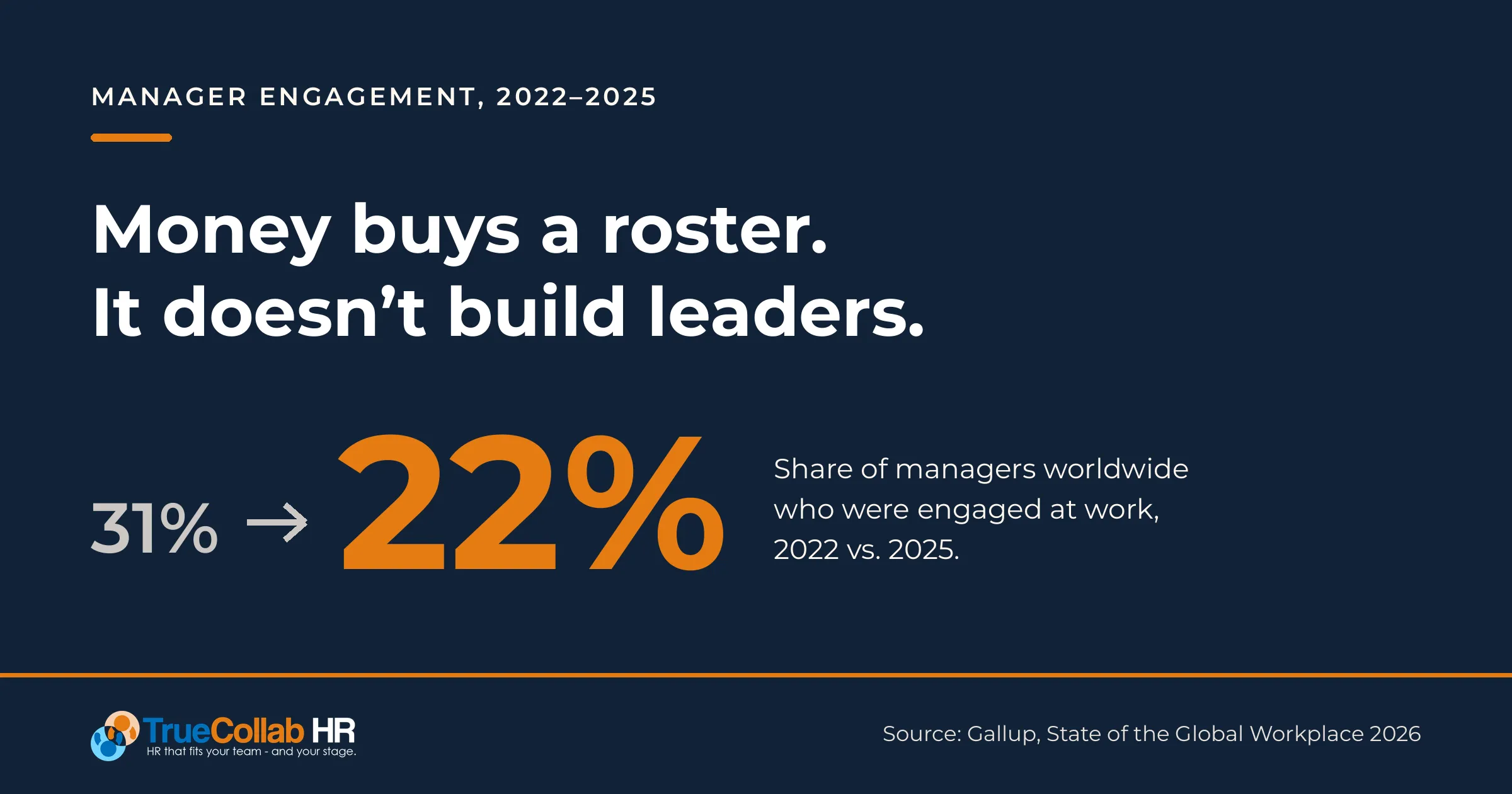
- Manager engagement worldwide fell from 31% in 2022 to 22% in 2025, while non-manager engagement barely moved, from 20% to 19% (Gallup, State of the Global Workplace, 2026).
- Gallup’s 2025 report found that manager training is associated with higher thriving among managers (34% vs. 28%), and that training plus someone at work who encourages their development is associated with 50%.
Note the word associated. Gallup isn’t claiming training alone produces those numbers. But the direction is consistent, and it matches what we see: managers who are developed handle their own problems, and managers who aren’t hand them up.
Why smaller companies feel it most
Picture a 40-person company with three or four managers and no one whose job is to develop them. Each of those managers carries a wide span: their own work, plus everyone who reports to them.
Gallup’s research on U.S. managers found that manager engagement declines as span of control grows, though manager talent and training can offset the effect. In a flat organization, that offset is the whole game. There is no layer above the manager to absorb the problems except the owner.
It cuts across both kinds of workforce we support. In a salaried, exempt team, an untrained manager tends to avoid the hard conversation until it becomes a termination. On an hourly, operational team, the same manager is also making daily calls on schedules, breaks, overtime and accommodation requests, where a well-meant mistake can become a compliance problem. Either way, the cost lands on the person who inherited HR on top of their real job.
What building a leader looks like in the first 90 days
The goal is a manager who builds capability on their team, not one who escalates problems to yours. Here is the sequence we use with new managers in companies of 20 to 150 people.
- Write down the job before day one. Which decisions the manager owns outright, which they recommend, and which still go to the owner. Most early friction comes from nobody saying this out loud.
- Teach the fundamentals in the first 30 days. Setting expectations, giving feedback that is specific and timely, and documenting it. For managers of hourly teams, add the operational basics: scheduling, breaks, overtime approval, and what to do when someone asks for an accommodation or leave.
- Hold a standing one-on-one with someone who develops them. Not a status meeting. A weekly conversation about the decisions they made, what they would do differently, and what is coming. That someone can be the owner, a senior leader, or an outside HR partner.
- Stop solving their problems for them. When the manager brings an issue, the first question back is “what would you do?” Answer it together, then let them carry it out. This is the shift from fixing problems to building the competency that prevents the next one.
- Hold the standard, and keep the relationship. When a manager misses, the consequence is real and the conversation is direct. Like the Contreras moment, it works only if the relationship was built before the miss.
- Review at 90 days against the written job. What do they now own without help? What still comes up the chain? The answer sets the next 90 days.
None of this needs a training budget the size of a big-market payroll. It needs someone whose job includes developing managers, and the discipline to do it every week.
It isn’t inevitable
Falling manager engagement is a trend, not a law. Gallup found that at its best-practice organizations, 79% of managers were engaged in 2025, nearly four times the global average of 22%. In the U.S., the figure was 36%. Those organizations span every region and industry; what they share is that developing managers is treated as part of the job.
Milwaukee couldn’t outspend Los Angeles, so it built what it couldn’t buy. Most growing companies are in the same position with their managers. You can’t hire your way out of a weak bench. You build one.
If you are the founder, COO or controller who inherited HR and spends too much of the week solving your managers’ problems, that is the work we do. Stop Wearing All the Hats.
Sources
- Associated Press, Brewers sweep the Dodgers in the NLCS to reach the World Series for the first time since 1982, October 16, 2026.
- ESPN, MLB playoffs: Takeaways from NLCS Game 4, ALCS Game 3, October 15, 2026.
- Yahoo Sports, MLB playoff team payroll, October 15, 2026, citing USA Today and MLB’s Labor Relations Department.
- CBS Sports, David vs. Goliath MLB playoffs won’t prove anything about a salary cap, October 2026.
- ESPN, Jeff Passan, How a Dodgers-Brewers NLCS defines MLB’s labor battle, October 2025.
- Roundtable, Pat Murphy Explains Brewers’ Formula for Finding Hidden Talent (Murphy on MLB Network), May 2026.
- MLB.com, Zach Sweet, How Murphy’s stern, authentic style has helped unlock Brewers’ success, September 28, 2026.
- Brewer Fanatic, After Signing a New Contract, ‘Lucky’ Pat Murphy Ready to Continue His Journey With the Brewers, February 2026.
- Gallup, Managers Account for 70% of Variance in Employee Engagement, from State of the American Manager, 2015.
- Gallup, State of the Global Workplace: 2026 Report, April 2026.
- Gallup, State of the Global Workplace 2025 press release, April 23, 2025.
- Gallup, span of control and optimal team size.